

Why Cumulative Volume Delta Fails Traders
Why aggression, totals, and hindsight narratives mislead traders
Most traders don’t look at Cumulative Volume Delta because they care about aggression.
They look at it because they’re trying to answer a much deeper question.
Who is in control?
Is initiative being accepted, or is it being absorbed?
Does aggressive participation actually matter at this price?
CVD feels like it should answer those questions. It looks objective and structural.
It feels closer to the truth than candles or patterns.
That’s exactly why it’s so misleading.
Why Traders Gravitate Toward CVD
CVD doesn’t win traders over in real time.
It wins them over after the session is over.
At its core, CVD promises clarity.
If aggressive buyers dominate, price should go up.
If aggressive sellers dominate, price should go down.
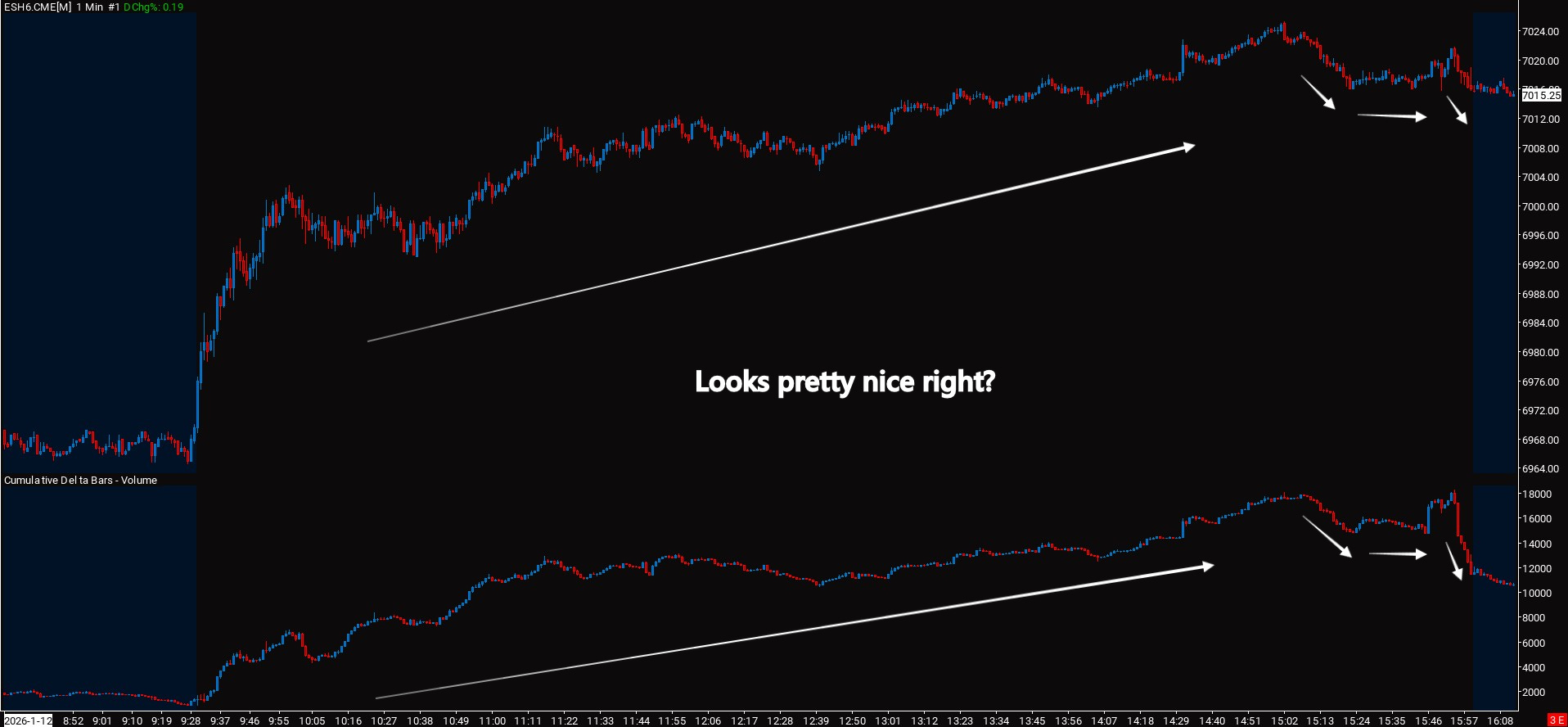
That story makes intuitive sense. It also fits neatly into how most traders think markets work.
The problem is that markets don’t reward aggression. They reward control.
Aggressive buying can be absorbed. Aggressive selling can be accepted. Initiative can exist without outcome.
CVD doesn’t measure control. It only measures who crossed the spread more often.
Why CVD Works So Well in Hindsight
After the session ends, CVD becomes very persuasive.
Price moved lower while CVD rose.
Buyers were absorbed.
That explains the move.
That explanation may even be correct.
But explanation is not execution.
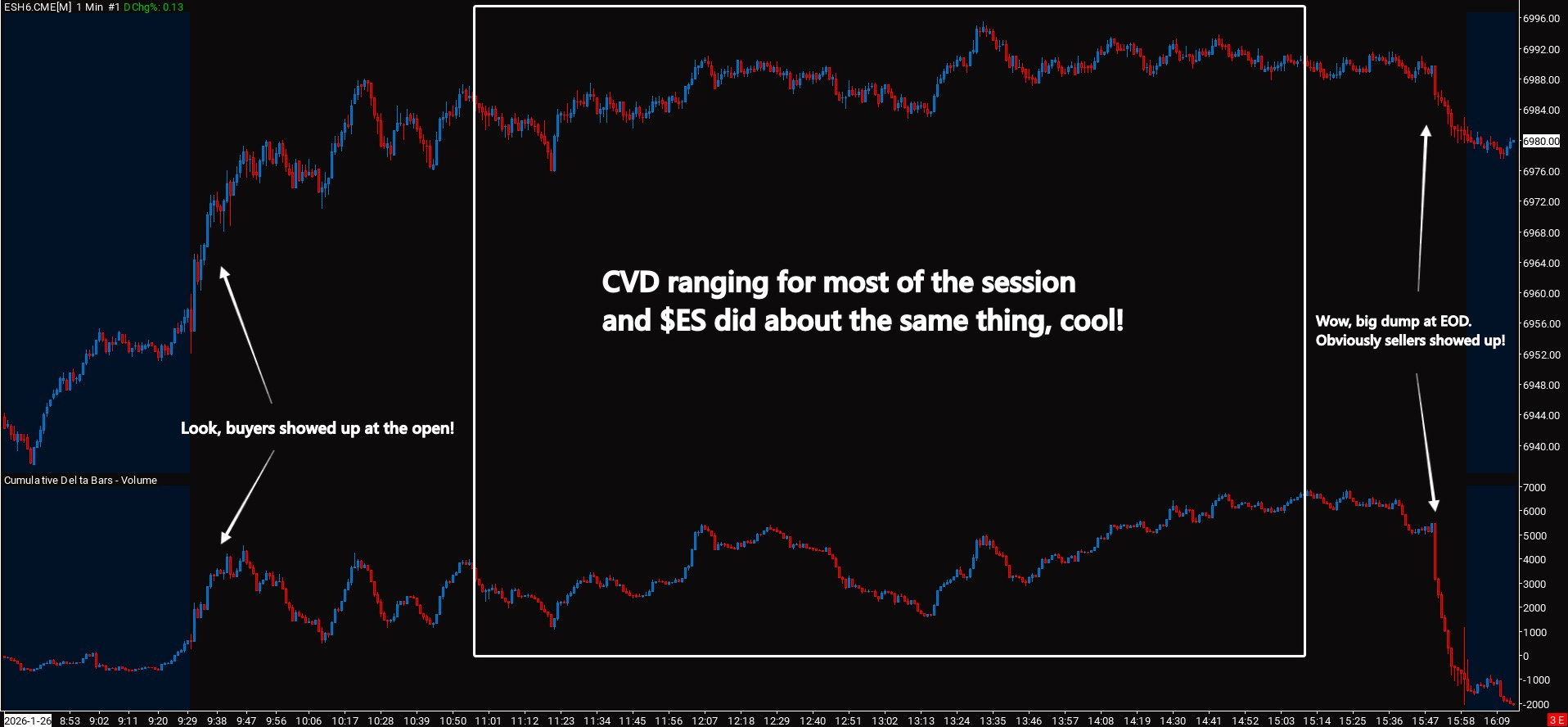
Tools that help you explain the past often fail you in real time, when uncertainty matters most.
Hindsight clarity feels like edge, but it rarely is.
What Cumulative Volume Delta Actually Measures
CVD is a running total of aggressive buying minus aggressive selling, starting from an arbitrary point in time.
That’s it.
It tells you who has been more aggressive since you started counting.
What it does not tell you is whether that aggression mattered.
It doesn’t tell you:
If liquidity was pulled or replenished.
If price was allowed to move.
If larger participants accepted that flow.
Aggression is an input. Outcome is what matters. CVD only captures the input.
The False Assumption About Price and CVD
Most traders implicitly assume that price and CVD should move together.
When they don’t, that gap becomes a “signal”.
But there is no rule in any market that says aggressive buying must lift price, or that aggressive selling must push it lower.
Price moves when trades are accepted. Not when they occur.
Once you accept that, the entire premise of using CVD directionally starts to fall apart.
Why CVD Sometimes Appears to Work
This is where divergence comes in.
Price makes a lower low.
CVD makes a higher high.
Price reverses shortly after.
It looks clean. It looks logical. It feels earned.
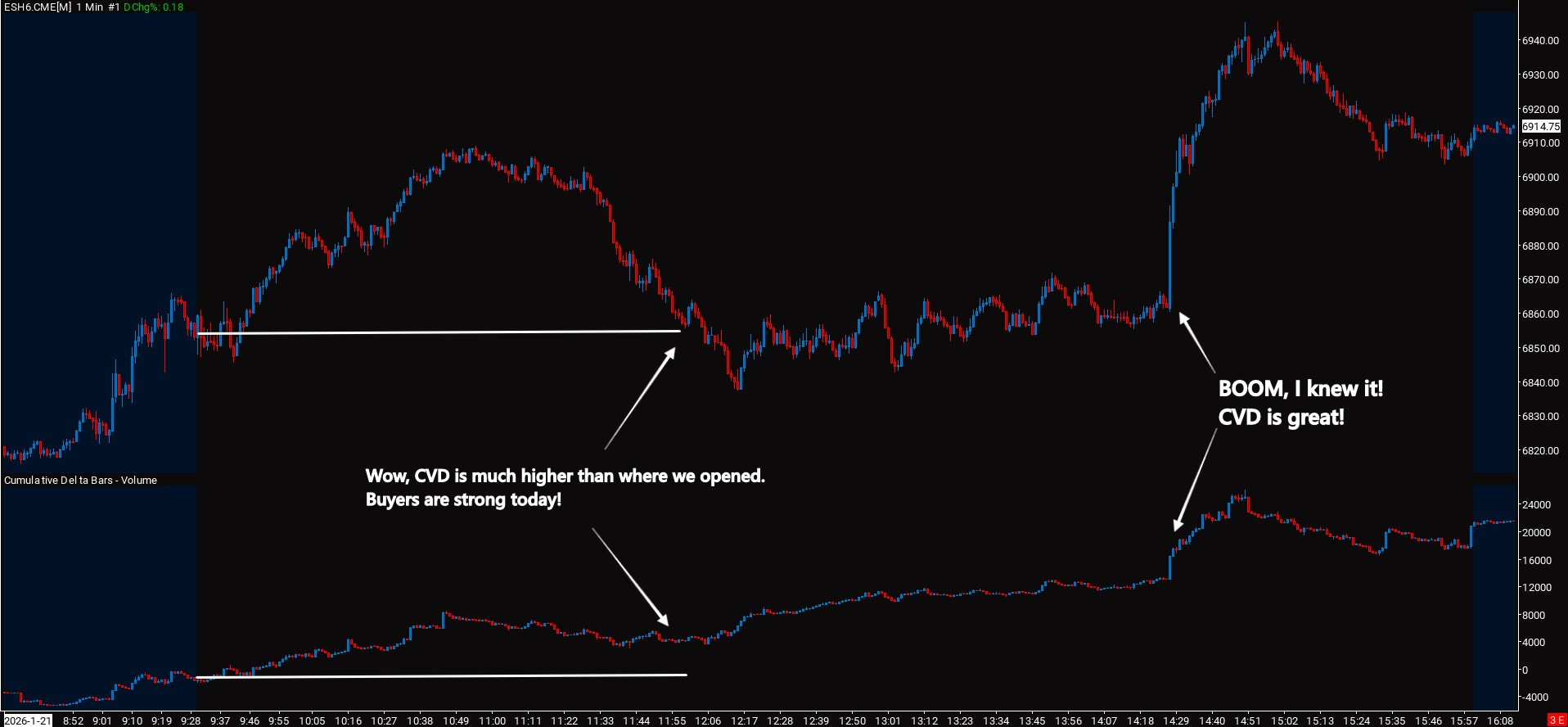
The issue isn’t that divergence is meaningless. The issue is that traders remember the times it works and forget the dozens of times it doesn’t.
Divergence is seductive because it creates a narrative. It gives you something to point to.
That doesn’t make it reliable.
When CVD Fails Repeatedly
If you watch enough sessions, you’ll see this clearly.
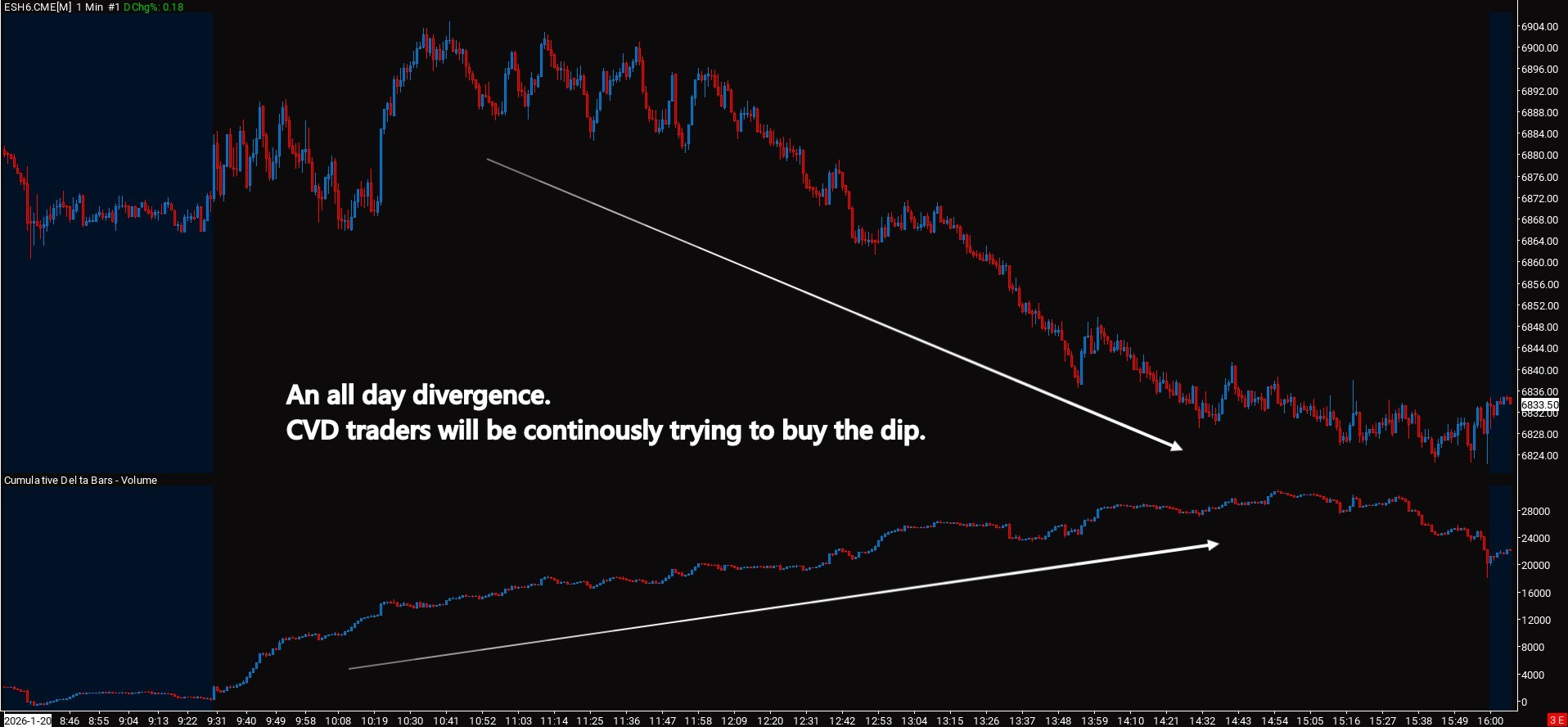
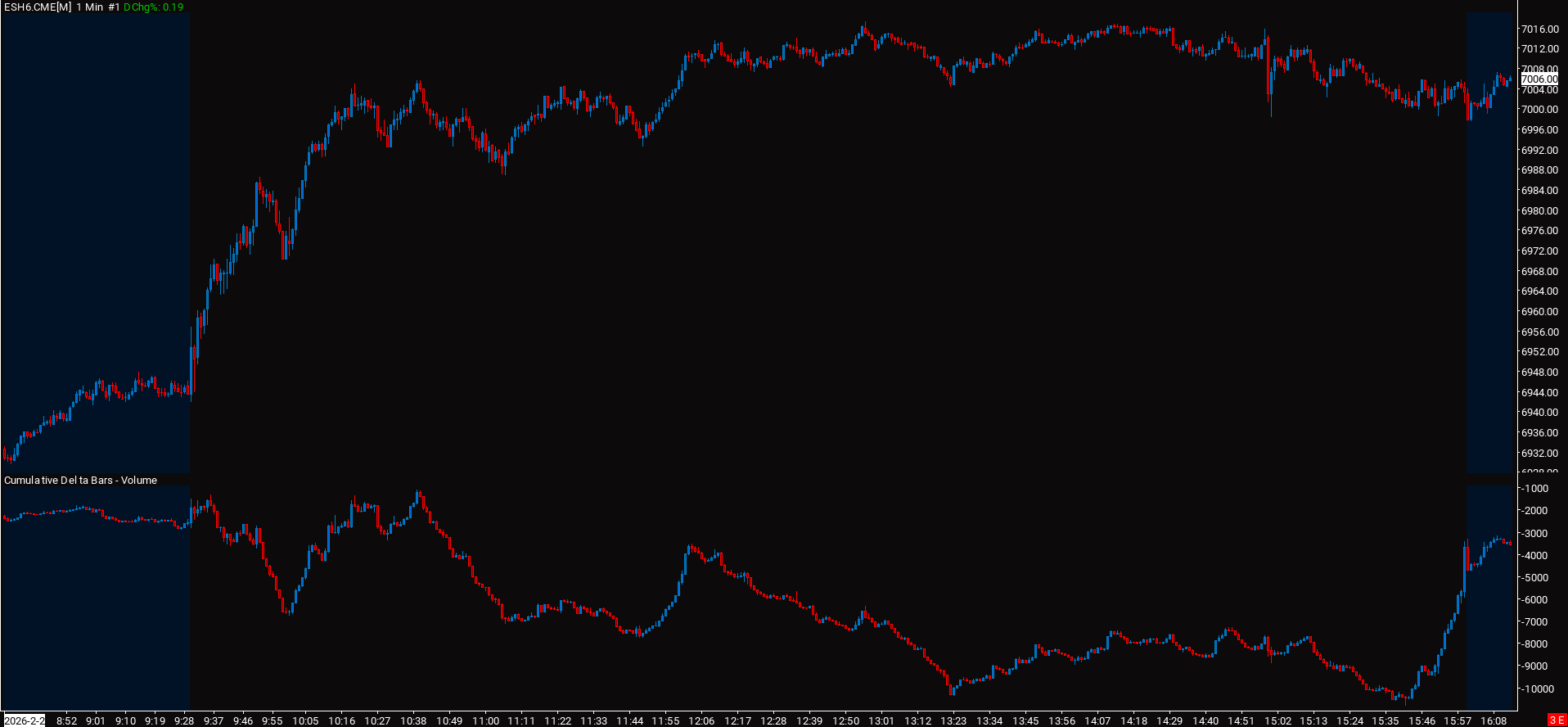
Price trends higher while CVD trends lower for hours.
Price trends lower while CVD steadily rises.
Nothing happens.
Absorption exists, but no reversal comes.
This is where traders start forcing trades because “it has to resolve eventually”.
It doesn’t.
CVD can diverge indefinitely because cumulative data has no timing component. It keeps counting long after the relevant information has passed.
The Real Problem: Time Aggregation
This is the core issue.
CVD aggregates information across the entire session, blending meaningful moments with irrelevant ones.
Markets don’t turn because of totals. They turn at inflection points.
Microstructure matters at specific locations. Not across six hours of trading.
Divergence can be useful when it occurs at a meaningful level, during a meaningful interaction, with a clear shift in behavior.
Session-wide divergence removes all of that context.
A Better Lens: Delta on Lower Timeframes
If you want to see aggressive behavior that actually matters, you don’t need cumulative data.
You need discrete measurements.
Delta on a lower timeframe tells you when something abnormal is happening now, not what has been happening all day.
Large delta relative to recent bars, occurring at a key location.
That’s where initiative becomes visible. That is data you need to pay attention to.
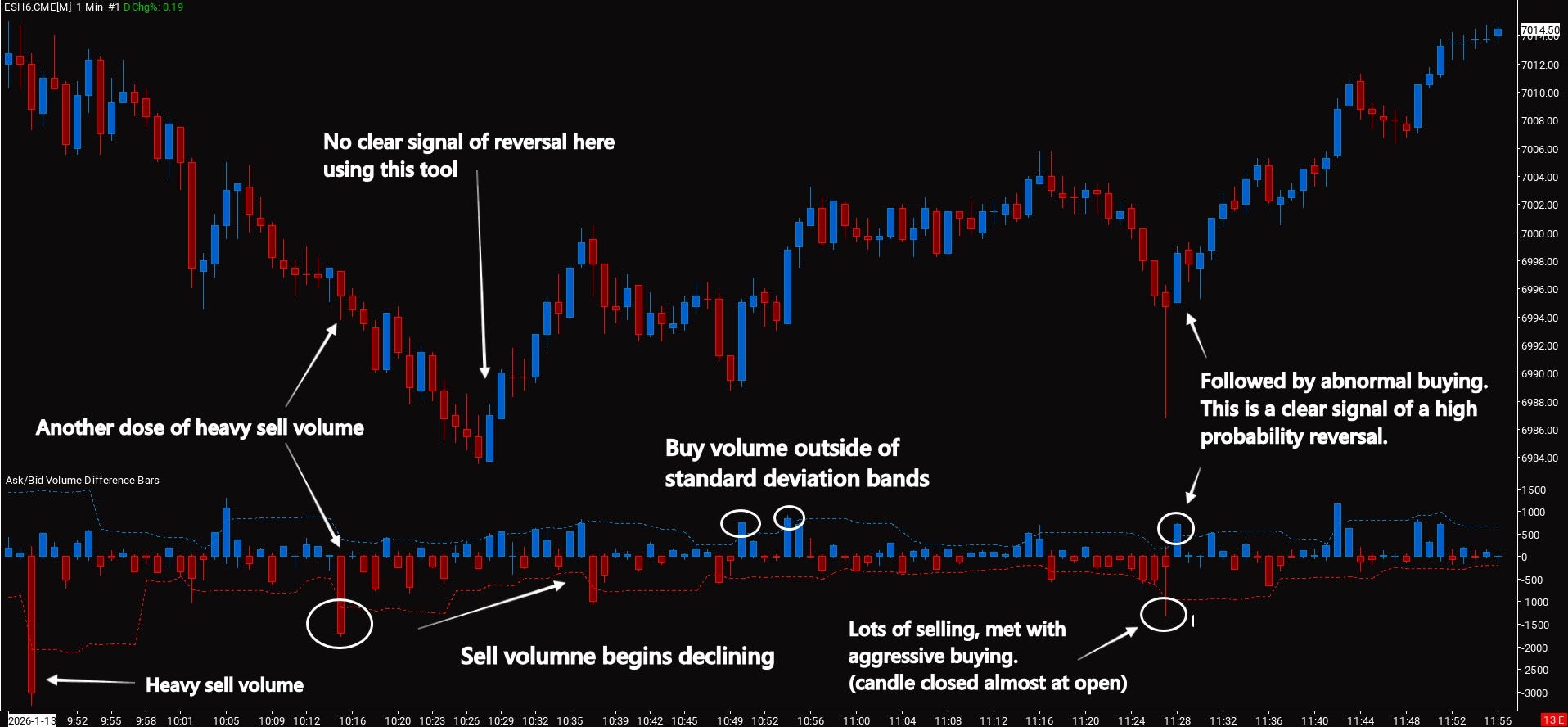
In the bottom subgraph I have “Ask-Bid Volume Difference Bars” and a “Standard Deviation Bands” study (dotted lines). The STD study allows me to quickly see when there’s abnormal volume, compared to the recent bars.
Try setting this up on your trading platform and observe it.
You will get more signal out of this than any CVD.
Finally: How I Actually Use CVD
I do use CVD as a nuanced datapoint.
Just not as a signal, and not the way most expect.
I don’t look at it in isolation, and I don’t care about its direction.
In a future post for paid subscribers, I’ll break down exactly what I compare it to and why that comparison matters more than CVD itself.
Legal Disclaimer
The content provided in this newsletter is for educational and informational purposes only and does not constitute financial, investment, trading, or any other form of advice. All views, opinions, and analyses expressed are those of the author and should not be interpreted as personalized recommendations to buy, sell, or hold any security, futures contract, option, or other financial instrument.
Trading futures, options, and equities involves substantial risk of loss and is not suitable for all investors. Past performance is not indicative of future results. You should carefully consider your financial situation, risk tolerance, and objectives before engaging in any trading activity.
The author and Beyond Candlesticks make no representations or warranties regarding the accuracy, completeness, or suitability of the information provided. We shall not be liable for any errors, omissions, or delays in the content, or for any actions taken in reliance thereon.
You alone are responsible for your own trading decisions and outcomes. Consult a qualified financial professional before making any investment or trading decisions.